Music Licence for Football Clubs in Switzerland: SUISA Guide
Switzerland: can your football club play Spotify at the ground? Which SUISA tariff applies to matches, what it costs and how to register.

Dario Tschannen
Published on
This guide is for clubs in Switzerland (SUISA). Is your club in Germany? Read music licensing for football clubs in Germany instead.
Walk-out music, a short jingle after a goal, something upbeat at half-time: at plenty of grounds, music over the PA is part of matchday. Usually it comes from someone's phone running Spotify, plugged into the mixer. That is where the trouble starts. This guide explains what a music licence for a football club in Switzerland involves: which SUISA tariff applies, why Spotify is still off limits and how to set things up properly.
Not legal advice. This article summarises publicly available tariffs and terms of use as of October 2026. SUISA's tariffs and SUISA's answer for your specific case are what count. Check your situation with SUISA's customer service.
Can a football club play Spotify at the ground?
In short: no. There are two separate reasons, and you need to solve both.
- Your contract with Spotify. Spotify's Terms of Use (last updated 26 August 2025) grant "limited, non-exclusive, revocable permission to make personal, non-commercial use" of the service. The User Guidelines also prohibit "performing", "broadcasting, or making available to the public" any content. A home match with spectators is not personal use.
- Copyright. Anyone who makes music audible in public needs a SUISA licence, whatever the source.
SUISA says so plainly on its background music page: the decisive factor is that music is made perceptible outside the private sphere, whether via radio, streaming or CD. And: "Existing contracts with streaming or radio providers do not replace a SUISA licence."
It works the other way round too: a SUISA licence does not fix the breach of Spotify's terms. SUISA pays composers, lyricists and publishers. What you may do with your personal Spotify account is governed only by your contract with Spotify. Apple Music is no different: the Apple Media Services Terms allow use "only for personal, noncommercial purposes". The YouTube Terms of Service let you view or listen to content "for your personal, non-commercial use".

Which SUISA tariff applies to music at a football match?
For music at a match, the relevant tariff is normally Common Tariff Hb (CT Hb), "music performances for dance and entertainment". According to SUISA's tariff overview, it runs from 2018 to 2027 and covers events outside the hospitality trade.
The tariff text (in German) names sports events explicitly. "Events with musical accompaniment" are those where music is played to frame "various festivities, meetings, fashion shows, sports events and similar events" (our translation), and where the music is not the main attraction. That is exactly a league match with walk-out and half-time music.
SUISA's online registration form for dance and entertainment also lists the "Sportanlass" (sports event) as an example of an event with musical accompaniment.
One point matters for clubs: CT Hb covers two sets of rights. SUISA represents the copyright of composers, lyricists and publishers. The neighbouring rights of performers and record producers belong to the repertoire of Swissperform. For this tariff, SUISA also acts for Swissperform, so you get one invoice that shows both shares.
What does music at a match cost?
We only quote what the tariff says. Amounts exclude VAT, and SUISA calculates your actual fee from the details you give.
- Small events: for events "in rooms with a capacity of up to 400 people" and an admission price below CHF 17.00, there are flat rates per day and event. For events with musical accompaniment and up to 100 people, that is CHF 33.30 for copyright and CHF 16.65 for neighbouring rights (up to 250 people CHF 55.50 and CHF 22.20, up to 400 people CHF 77.70 and CHF 27.75).
- Larger events: otherwise SUISA charges a percentage of the income (5 % copyright, 1.5 % neighbouring rights for events with musical accompaniment) or, where there is no admission income, a percentage of the music costs (PA system, DJ, recordings). The minimum per day is then CHF 77.70 and CHF 27.75.
- Discount with an annual contract: clubs that settle all their events under one contract with SUISA get 10 % off, plus another 5 % with more than 10 events a year.
- Double without permission: if music is used without SUISA's permission, the fee is doubled.
Whether an open-air pitch counts as a "room" with a capacity, and how many home matches you can bundle in one contract, is best clarified with SUISA directly. A season easily has 11 to 13 first-team home matches, plus youth and veterans' games.
Is there a blanket agreement through the football association?
Some other sports federations have collective agreements with SUISA. A Swiss Ice Skating leaflet describes one: the federation pays a flat fee and its clubs may use protected music at their own events. The Swiss Gymnastics Federation had a similar arrangement according to its 2013 SUISA leaflet.
For the Swiss Football Association (SFV/ASF) we found no such agreement when researching in October 2026, and none for the regional associations or Swiss Olympic either. It is still worth asking your regional association. CT Hb grants national federations that settle for all their members an additional 20 % discount.
Which licence for which situation?
| Situation at the club | What you need |
|---|---|
| Walk-out and half-time music at home matches | SUISA licence under CT Hb (event with musical accompaniment), plus a legal music source |
| Goal jingle or walk-on music | same licence as above, the jingle is part of the music at the event |
| Background music in the clubhouse or bar | SUISA licence under CT 3a, minimum charge is one month's fee |
| Bingo night or club evening with recorded music | CT Hb, usually as an event with musical accompaniment |
| Disco or party with a DJ | CT Hb as a dance event |
| Band concert longer than one hour | CT K (concerts) |
| Public viewing of a World Cup match in the clubhouse | CT 3a up to a 3 m screen diagonal, CT 3c above that, see SUISA blog |
| Music in the match livestream | no SUISA solution for the club, follow the platform's rules (see below) |
| Spotify, Apple Music, YouTube on a personal plan | not allowed, not even with a SUISA licence |
Where your music can legally come from
Once Spotify is out, there are three clean options.
Your own audio files
Purchased CDs or downloads are the classic route. CT Hb even states that you may record music onto your own media for your own events, as long as you do not pass them on. Do read the download shop's terms, though: Apple's Media Services Terms, for example, also limit purchased content to personal use. If in doubt, a shop that does not exclude use at events is the safer choice.
Business music services
Some streaming services are built for businesses, such as Soundtrack Your Brand and other B2B providers. They advertise music licensed for business use. Check whether your contract also covers outdoor events. And SUISA's point still applies: the provider's contract does not replace the SUISA licence. Ask the provider which rights are included for Switzerland.
Royalty-free and "SUISA-free" music
"GEMA-free", "royalty-free" or Creative Commons sounds like the easy answer. On its page about SUISA-free music, SUISA warns that music sold as licence-free is often not licence-free at all. If you use it, you file a list of all titles with composers and lyricists with SUISA. For recordings that are sold to the public, the neighbouring rights share is still payable according to SUISA.
With Creative Commons music, also check the licence variant: "NC" (non-commercial) licences exclude commercial use, and a home match with admission and sponsors is hard to argue as non-commercial.
Goal music, walk-on tracks and livestreams
Goal jingles and walk-on music are nothing special in copyright terms. They are music played publicly at the event, so the same CT Hb licence covers them as the half-time music. Even a ten-second clip is a protected work. If a club member composed the jingle and is not a SUISA member, say so to SUISA with your track list.
In a livestream, the SUISA licence for the ground does not apply. The platform handles music in uploaded content itself. YouTube detects protected music with Content ID; rights holders can block a video, monetise it with ads or just track its statistics. For live streams, YouTube's help page says a placeholder image may replace your stream, or it may be interrupted or terminated. In practice: don't feed the stream audio from the PA. Use your own microphone or commentary instead. To put the score on screen, see our post on the stream overlay for OBS and vMix.
Setting up music at the ground legally, step by step
- Take stock. Where does music play? Home matches, youth tournaments, clubhouse, bingo night, club party. Each situation needs its tariff, see the table above.
- Change the source. Replace the personal Spotify account with your own audio files or a business music service.
- Confirm the tariff with SUISA. Call or write to customer service and describe a typical home match: attendance, admission price, when music plays.
- Register. For individual events, use the online form for dance and entertainment. There you can also request an annual contract, which is 10 % cheaper. Register the clubhouse separately under CT 3a; SUISA gives a 5 % discount for registering through its customer portal.
- Meet the deadlines. Under CT Hb, you report the figures needed for the calculation within 10 days of the event, unless your licence says otherwise. SUISA only asks for track lists for events in rooms holding 400 people or more, within 30 days.
- Assign responsibility. Decide on the committee who manages the licences and keeps the music list up to date. Announcers and match officials then play only music from that list.
How LemonScore handles music
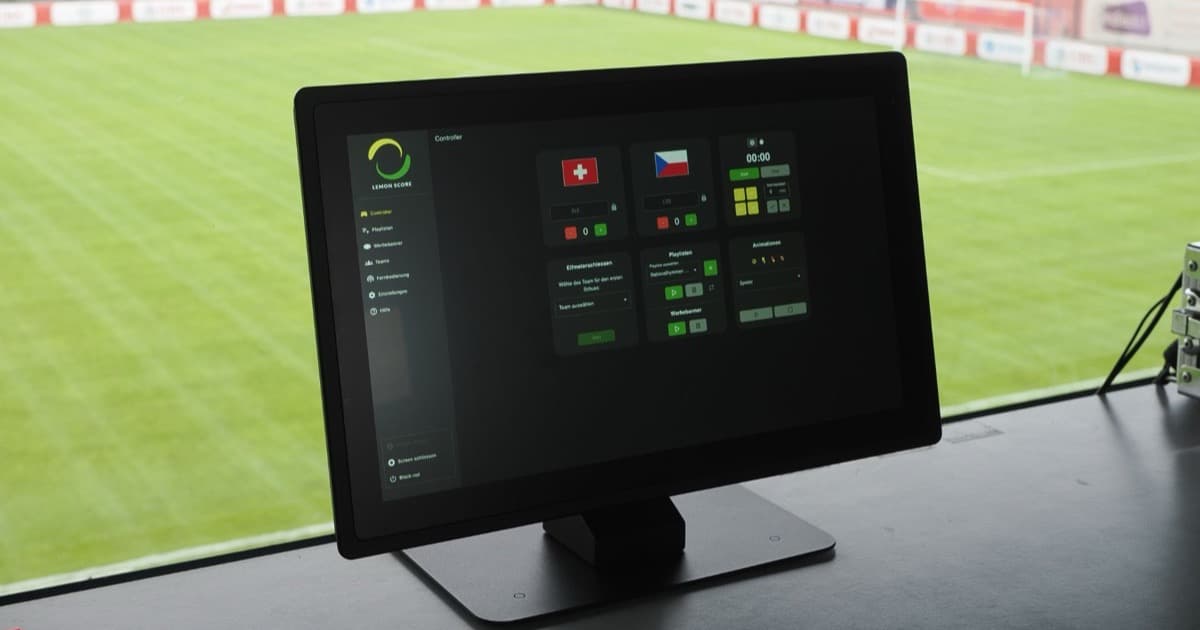
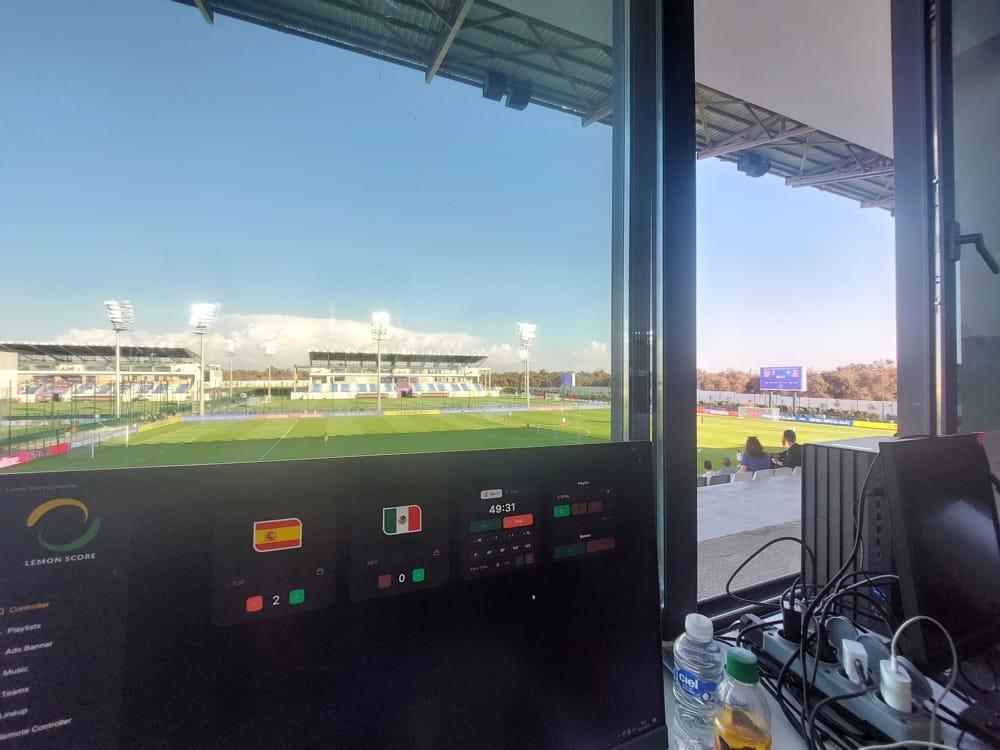
LemonScore does not include any music and is not a streaming service. Under Music you create playlists and upload your own audio files: MP3, WAV, FLAC, AAC, OGG and M4A. Playback goes through the sound output of the computer running LemonScore, for example into the PA mixer. The details are in the Music documentation.

A practical setup for matchday: create separate playlists such as "Walk-out", "Half-time" and "Full-time". Show the Music card on the controller via the lock icon and pick the playlist in the Select playlist field. You can also control music from the remote control, with shortcuts (for example "Half-time": stop the clock, show the ads banner, start the music) and from a Stream Deck.

The simplest way to play a goal jingle is to attach it to the goal animation. In the animation editor, click Add sound in the Audio row, then choose the part of the track in the Choose audio section dialog. The jingle then plays exactly when the animation appears on screen. More in our post on building your own animations.

Important: which files you upload, and whether you hold a licence for them, is the club's responsibility. LemonScore plays what you add and cannot check the rights to your files.
Is your club in Germany? There GEMA is responsible, and many clubs are covered by their state sports federation's flat-rate agreement: see music licensing for football clubs in Germany.
Frequently asked questions
Does an amateur club really need a SUISA licence for music at matches?
Yes. As soon as spectators can hear the music, it is a public performance. CT Hb names sports events explicitly as events with musical accompaniment. Free admission does not change that; it only affects how the fee is calculated.
Is Spotify fine if the club pays SUISA?
No. The SUISA licence covers copyright; your Spotify contract covers use of the service. Spotify permits only personal, non-commercial use and prohibits public performance. That applies to Premium accounts too.
How much does a SUISA licence cost for a home match?
It depends on attendance, admission price and music costs. For small events with musical accompaniment and up to 100 people, CT Hb sets flat rates of CHF 33.30 (copyright) plus CHF 16.65 (neighbouring rights) per day, excluding VAT. SUISA calculates the binding amount.
Is Swissperform included in the SUISA invoice?
For CT Hb and CT 3a, yes. SUISA collects the neighbouring rights fee on behalf of Swissperform. You pay one invoice with two shares.
Can I cut a goal jingle from a well-known song?
Playing it at the ground falls under the same CT Hb licence as your other music, short clips included. The source must be legal, though: your own file, not a recording taken from Spotify or YouTube. If you rework a song heavily, for example with new lyrics or as a remix, check with SUISA first.
Does the Swiss Football Association have an agreement with SUISA?
In October 2026 we found no publicly documented blanket agreement for the SFV or its regional associations. Other federations such as Swiss Ice Skating have one. Ask your regional association.
Conclusion
Music belongs on matchday, but it needs two things: a legal source and a SUISA licence. CT Hb covers music at matches, CT 3a the clubhouse. Spotify, Apple Music and YouTube on personal plans are not an option, not even with a SUISA licence. If you keep your own files in playlists and tie the goal jingle to the goal animation, your music is under control and easy to document. See what else LemonScore does on matchday on the features page. The role of music, jingles and playlists in the software for your scoreboard is explained on the product page.