Music Licence for Football Clubs in Germany: GEMA Guide
Germany: what the DOSB flat-rate GEMA agreement covers for sports clubs, when to register music at your ground and why Spotify is off limits.

Dario Tschannen
Published on
This guide is for clubs in Germany (GEMA). Is your club in Switzerland? Read music licensing for football clubs in Switzerland instead.
It is 2.45 on a Saturday afternoon and the district league side is about to kick off. A speaker stands on the clubhouse terrace, a laptop is playing a Spotify playlist, and the goal song is queued up for the first home goal. Almost every amateur club in Germany does something like this, and very few know exactly which parts are allowed. This guide walks through the GEMA football club music licence question step by step: what the flat-rate agreement between the DOSB and GEMA covers, when you still have to register, and why Spotify is not an option.
Note: this article is not legal advice. It summarises publicly available rules as researched in October 2026. What counts is your state sports federation's agreement and GEMA's own answer.
A quick glossary for readers outside Germany: GEMA is the German collecting society for composers, lyricists and publishers. The GVL collects for performers and record labels. The DOSB is the German Olympic Sports Confederation, and each federal state has its own sports federation, the Landessportbund (LSB), which most clubs belong to.
Can we play Spotify at the ground?
Short answer: no. And a GEMA licence does not change that.
The problem is not GEMA but the streaming service's terms. Spotify's Terms of Use grant you "limited, non-exclusive, revocable permission to make personal, non-commercial use of the Spotify Service and the Content". Its User Guidelines also rule out "performing", "broadcasting" and "making available to the public".
The other big services say the same:
- Apple Music and iTunes: under the Apple Media Services Terms you "may use the Services and Content only for personal, noncommercial purposes". That applies to all services, including tracks you have bought.
- YouTube: the German Terms of Service allow you to watch or listen to content for your personal, non-commercial use.
A GEMA licence pays the songwriters. It does not give you permission that the streaming service itself withholds in the contract you signed as a customer. If Spotify runs through the PA, the club is in breach of those terms even if its GEMA paperwork is perfect.
The DOSB and GEMA flat-rate agreement
The good news: for most of what an amateur football club does with music, the bill is already paid. The DOSB has a flat-rate agreement with GEMA running from 1 January 2026 to 31 December 2029. It covers every state sports federation and its member clubs. The DOSB publishes an excerpt of the agreement as a PDF (in German).
Payment runs through your state federation. According to LSB NRW, the flat rate is collected automatically by each federation per club member and calendar year: EUR 0.157 net per member in 2026. The agreement also states that the GVL fees are included in the flat rate.
What the agreement covers for football clubs
From the list of covered uses, these matter most to a football club:
- Interval music at sports events: "musical framing" of sports events, but only at amateur events with no more than 1,000 spectators.
- Sports days and family fun days, as long as there are no significant other activities. Shows and galas with an admission charge are excluded.
- Christmas and end-of-season parties without dancing, annual general meetings and youth parents' evenings without dancing.
- Youth section carnival parties with free entry, attended only by children, teenagers and accompanying adults.
- Radio and music in a club room, but only in rooms that are not commercially run and are open to members only.
- Music on the club website when the club reports on its own events.
What it does not cover
- Matches with more than 1,000 spectators. For these, the agreement points to GEMA tariff M-SP.
- Parties with dancing, such as the end-of-season party with a DJ, and shows or galas with an admission charge.
- A clubhouse with a bar. As soon as food or drink is sold, the room counts as commercially run. According to GEMA, background music there has to be licensed separately, by either the club or the tenant running the bar.
- Music during play. The agreement only covers "framing". GEMA defines that in tariff M-SP: music before the start, at the end or during breaks, no more than 30 minutes in total, not during the competition and not as a backing for extra programme items such as announcements.
The simplest way to check whether your club is covered is to ask your state federation. GEMA's own page for sports clubs refers questions about covered events back to "your federation". Many federations publish their own FAQ, for example LSB NRW, LSB Brandenburg and LSB Niedersachsen.
What about the new NRW state agreement?
Since 1 July 2026, the state of North Rhine-Westphalia has its own GEMA agreement for volunteer-run associations. LSB NRW says it does little for sports clubs: it only covers up to four free-entry events a year on up to 500 m², and sports events are excluded. The DOSB agreement takes precedence.
Goal music, walk-out music and the announcer
This is where most clubs get caught out.
- Walk-out music before kick-off and half-time music are classic "framing". At an amateur match with up to 1,000 spectators, the flat-rate agreement covers them.
- A goal song plays during the match. On its page for sports clubs, GEMA classes events where music is played during the competition as a music performance, not as framing. Ask your state federation in writing whether it treats a short goal song as covered.
- Music under the announcer's voice counts as a performance on the same page, which lists music for programme items "such as cheerleaders or announcements".
If you want to be safe, play music only before kick-off, at half-time and after the final whistle, and keep the PA quiet during play.

Tariff M-SP when the agreement does not apply
Anything outside the agreement is registered in the GEMA online portal. Sports events fall under tariff M-SP. The key rates (version 16, valid from 1 April 2026, net plus 7% VAT):
| Situation | Fee under tariff M-SP |
|---|---|
| Amateur match, music only as framing (before, after, in breaks, max. 30 minutes) | EUR 15.10 per 150 spectators |
| Sports event with a music performance (e.g. announcements, music during play) | EUR 30.20 per 150 spectators |
Two more points that are easy to miss:
- 20% framework discount: as a member of a state federation you get 20% off, but only if you register the event at least 3 days in advance, pay on time and use the official channels (LSB NRW).
- 20% GVL surcharge: for recorded music, including MP3 files, GEMA adds a 20% GVL surcharge to its base rates.
Worked example: the cup derby draws 1,200 spectators, and music plays only before kick-off and at half-time. That is 8 x 150 spectators, so 8 x EUR 15.10 = EUR 120.80 net under the tariff. With the 20% framework discount you are left with EUR 96.64, plus the GVL surcharge and VAT. The price calculator in the online portal shows the exact figure.
What if you do not register?
GEMA then claims damages. Its invoice terms state that, in line with established case law of the highest courts, "the inspection cost amounts to 100% of the standard tariff fee". In practice you pay double, and you lose the framework discount. The flat-rate agreement does soften this slightly: no inspection costs are charged for a club's first breach of the registration rules.
Where should the music come from?
With streaming services ruled out, you need a source whose terms allow public playback.
- Original recordings and files: a CD you bought does not come with streaming-style terms of use. Be careful with copies, though: ripping CDs or copying files for public playback falls under GEMA tariff VR-Ö. GEMA says no fee is due if you only use original music files. Check the terms of download stores too: Apple's personal-use restriction also applies to purchased tracks.
- Music services for businesses: some streaming services are licensed specifically for public playback in shops and venues. Check the contract to see whether GEMA and GVL fees are included or charged separately.
- GEMA-free music: possible, but it takes effort. Under the so-called GEMA presumption (in German), it is up to you to prove that the music is not in GEMA's repertoire. GEMA itself says that GEMA-free music must still be reported to it. Keep the provider's licences and certificates.
- Creative Commons: only use tracks with a suitable licence and credit the artists. LSB NRW points out that commercial uses remain prohibited under "CC-NC" licences, for example advertising a paid club event.
Music in your livestream
If you stream matches on YouTube or Facebook, there is a third layer. The flat-rate agreement covers music on the club website when you report on your events, but a livestream on a platform is something else. According to LSB NRW (in German), you need the label's master rights as well as GEMA rights, and club accounts do not count as private users under platform licences.
The technical side matters even more. If YouTube detects copyrighted material, its help page says the livestream may be replaced by a placeholder image and, if the problem continues, interrupted or stopped. Music from the ground's speakers reaches the stream through the camera microphone very easily, so pause the music at half-time or mute the stream audio. To put the score and match clock into the picture, see our guide to the stream overlay for OBS and vMix.
Playing music with LemonScore
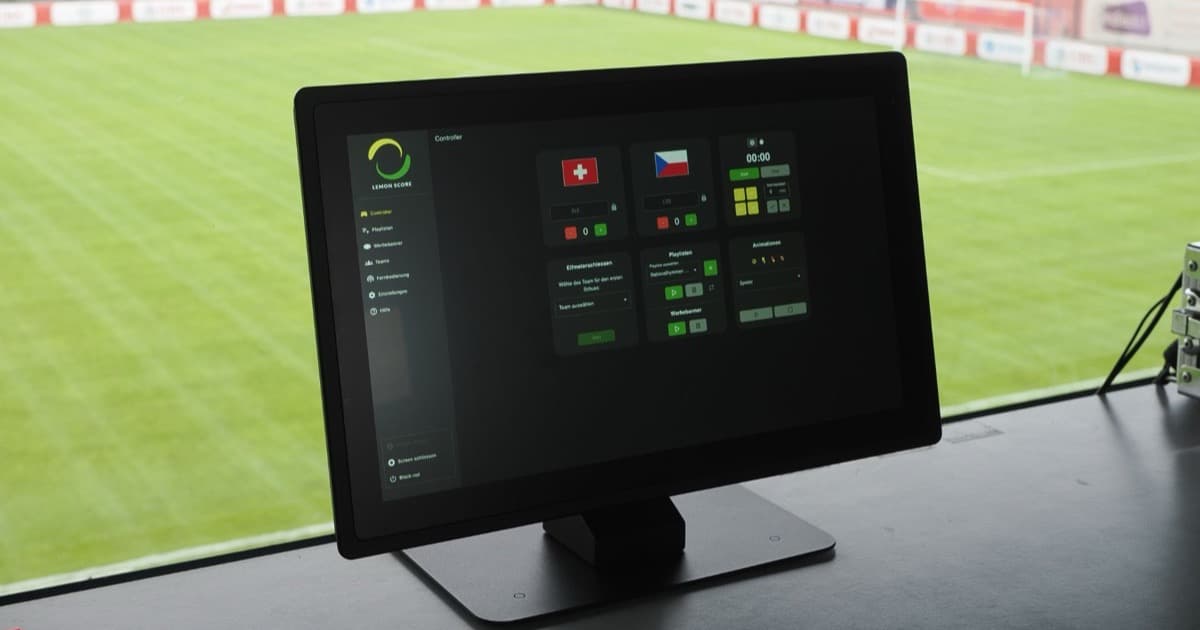
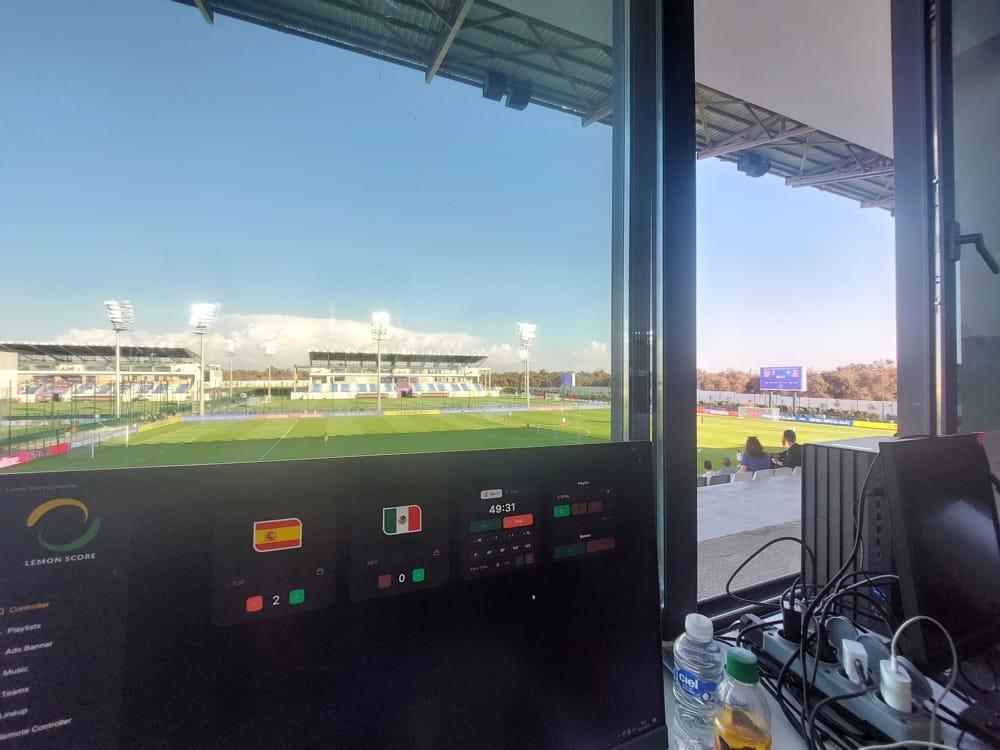
The scoreboard software LemonScore has a built-in Music page. You create playlists there, say "Walk-out" and "Half-time", and use Add Tracks to add your own audio files (MP3, WAV, FLAC, AAC, OGG or M4A). Music plays through the sound output of the computer running LemonScore. There is no link to Spotify or any other streaming service: LemonScore only plays files you upload yourself.

During the match you control the music from the Music card on the controller, or from your phone using remote control. That way the walk-out music starts the moment the teams leave the dressing room and stops in time for kick-off. The card is included in every plan. All the steps are in the Music documentation.

One thing to be clear about: LemonScore is a playback tool. The club is responsible for the rights to the music it uploads and for any GEMA registration.
Matchday checklist
- Remove streaming apps from the PA laptop. Spotify, Apple Music and YouTube are off limits for public playback.
- Provide your own music: original files, a business music service or music you can prove is GEMA-free.
- Check with your state federation that your club is a member and which uses the agreement covers. Ask specifically about the goal song.
- Play music only before kick-off, at half-time and after the final whistle, no more than 30 minutes in total.
- Register with GEMA for crowds over 1,000, parties with dancing and a clubhouse with a bar, at least 3 days in advance.
- Keep ground music out of the livestream or mute the stream audio during breaks.
Is your club in Switzerland? Different rules apply there: see music licensing for football clubs in Switzerland.
Frequently asked questions
Can a football club play Spotify in public?
No. Spotify only permits personal, non-commercial use. That holds even if the club has registered with GEMA or the flat-rate agreement covers the event.
Does our football club have to register music with GEMA?
Not for interval music at amateur matches with up to 1,000 spectators, provided your club is a DOSB member through its state federation. The flat-rate agreement covers that. You do need to register larger matches, parties with dancing and background music in a clubhouse with a bar, among other things.
Is goal music covered by the flat-rate agreement?
It is not clear-cut. The agreement covers "musical framing", and GEMA understands that as music before, after and during breaks, not during the competition. Ask your state federation and get the answer in writing.
How much does a GEMA licence for a football match cost?
For interval music only at an amateur match, EUR 15.10 per 150 spectators under tariff M-SP, minus the 20% framework discount for federation members. Add the 20% GVL surcharge for recorded music and 7% VAT.
Are GVL fees included in the flat-rate agreement?
Yes. According to the agreement excerpt, the fees for GVL, VG Wort and Corint Media are included in the flat rate.
What happens if we do not register an event?
GEMA claims damages, usually double the tariff, because the inspection costs amount to 100% of the standard fee. Under the flat-rate agreement, no inspection costs are charged for a first breach.
Conclusion
For a typical amateur matchday, GEMA is simpler than its reputation: the DOSB agreement covers interval music for up to 1,000 spectators, paid through your state federation. The real risk at many grounds is the Spotify playlist, which no GEMA agreement can fix. With your own audio files in a tidy playlist and clear rules for goal music and the livestream, your club is on safe ground. See what else LemonScore handles on matchday in the feature overview, and if your club is planning a new scoreboard at the same time, we have summarised the funding programmes in Germany. How playlists with your own files run in the scoreboard software is shown on the overview page.