Match Clock in Football: Rules, Stoppage Time and the Scoreboard
Football match clock explained: what the scoreboard may show, why the clock stops at 45:00 and 90:00, and how to display stoppage time and penalty shootouts correctly.

LemonScore
Published on
The clock on the scoreboard shows 90:00, the referee lets play continue, and the first people in the stands start asking whether the board is broken. Anyone who works as announcer, timekeeper or scoreboard operator at their club knows this moment. The match clock in football is not what many spectators think it is: it is information, not the basis for a decision. The referee keeps the time; the scoreboard merely follows him.
This article explains, from a club's point of view, what the match clock on the scoreboard may show, how to display stoppage time, extra time and penalty shootouts, which match lengths apply in youth football, and which operating mistakes happen on match day.
Basic rule: the referee is the timekeeper
Law 7 of the IFAB Laws of the Game (The Duration of the Match) states that the referee adds on the time lost in each half: for substitutions, injuries, time-wasting, goal celebrations and all other stoppages. At the end of the last regular minute, the fourth official shows the minimum stoppage time. The referee may extend it, but not shorten it.
For the club, this means:
- The match clock in the stadium does not bind the referee. He plays by his own watch.
- The scoreboard is a service for spectators, the announcer, the kiosk and the live stream.
- In case of any discrepancy, the referee's watch always applies, never the board.
The fourth official's substitution board (the number held up in the 45th and 90th minute) is not the scoreboard at the pitch. The scoreboard operator enters the stoppage time once it is official, not before.
What the match clock on the scoreboard may show
In Swiss amateur football, there is a clear practice. The referee guidance sheet issued by the SFV referee committee (regional associations such as AFV or FVNWS publish it on their websites) states: at matches with a match clock, the clock must be stopped once regular playing time has elapsed. In concrete terms, the clock stays at 45:00 and at 90:00. Stoppage time is not counted down; it is communicated via the fourth official's board (where available) or an announcement by the announcer. The same guidance sheet gives 30 seconds per substitution as a reference value for stoppage time; if a substitution takes longer, the time actually lost counts. Check the exact wording in the current edition, as the guidance sheets are updated regularly.
The reason: if the clock runs past 90:00, the stands and the bench get the impression that the board knows when the match ends.
Who changed the rules most recently?
Two developments from professional football raise questions at clubs:
- Swiss Football League from the 2026/27 season: according to media reports (watson.ch, July 2026), the SFL has let the match clock in Super League stadiums keep running during stoppage time in both halves since the start of the season, instead of stopping it at 45:00 and 90:00. The SFL's directives to its clubs are decisive here.
- DFL from 2026: in December 2025 the Deutsche Fussball Liga decided (DFL release 72/2025) to display the stoppage time set by the referee in Bundesliga and 2. Bundesliga stadiums in future. Until now, the match time display there stopped at 45:00 and 90:00 at the end of regular playing time.
Important for amateur clubs: both rules apply only to the professional leagues. In amateur football, the directives of the SFV and your regional association remain decisive; anyone wanting to adopt the professional practice should ask the referee coordinator first. Permitted in any case: showing stoppage time as an addition next to the stopped clock, for example "90:00 +4". That is not a running clock and does not contradict the guidance sheet.
Count-up, countdown, extra time and penalty shootouts
In football, the count-up clock (00:00 to 45:00 and 45:00 to 90:00) is the standard, because it matches the match minute that referees and spectators have in their heads. A countdown is unusual for the match itself, but useful for the half-time break: a 15-minute countdown tells spectators and the kiosk team when play resumes, and stops by itself at 00:00. In LemonScore, you switch to timer mode for this; switching resets the time, so only switch during the break.
Extra time
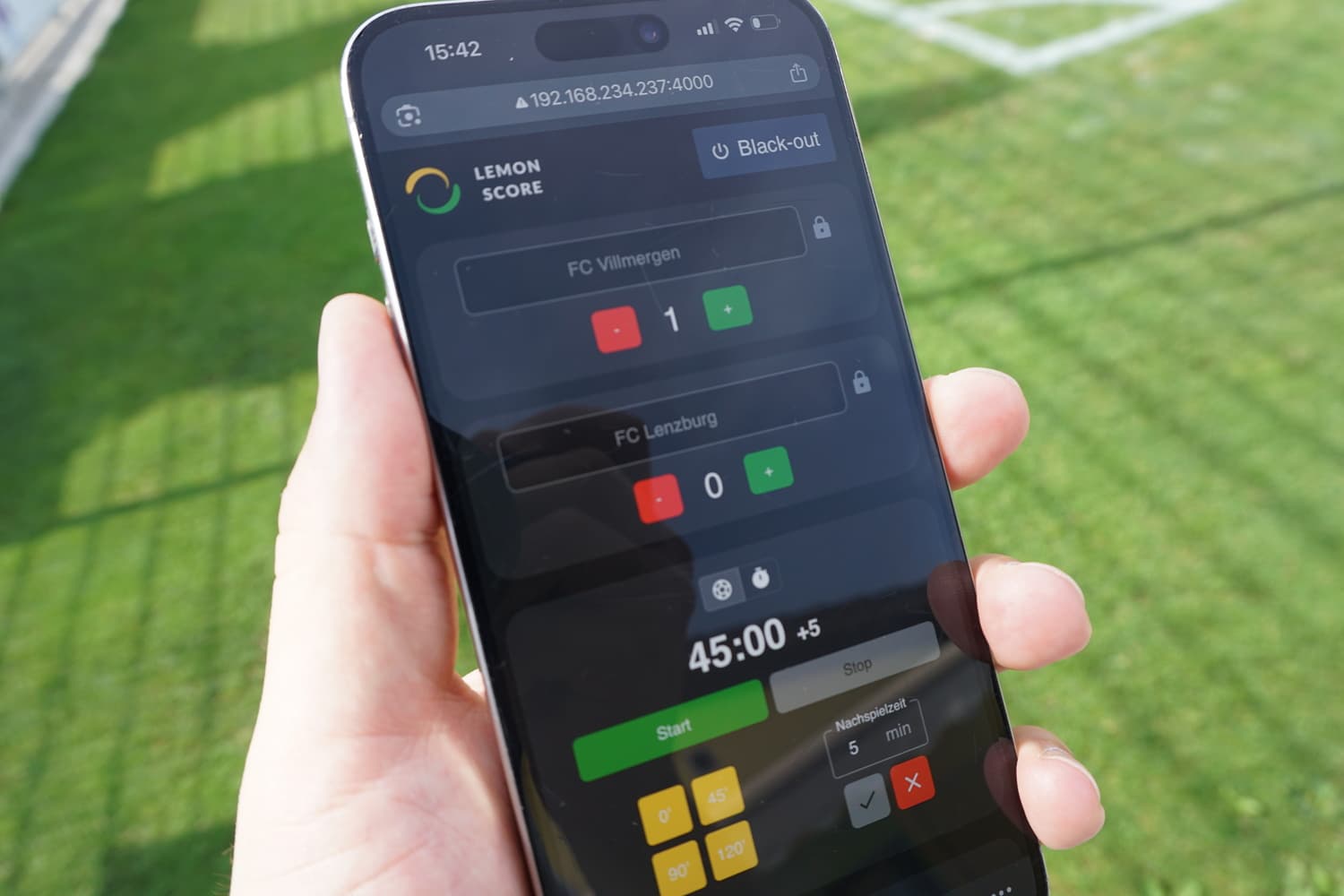
If a cup match ends in a draw, depending on the regulations it goes to extra time of 2 x 15 minutes: the clock runs from 90:00 to 105:00 and from 105:00 to 120:00. The quick-select buttons for 90' and 120' save setting the time manually, and the "stop match clock automatically" option halts the clock at 45, 90 and 120 minutes without the operator having to remember it in the middle of a goal celebration.
Penalty shootout
During a penalty shootout, the scoreboard no longer shows a clock but the order and outcome of each kick: scored, missed or saved, five attempts per team, then sudden death with one kick per team per round. A good penalty shootout mode on the scoreboard switches the team automatically after each kick; how this looks in LemonScore is described in the documentation on the penalty shootout.
Youth match lengths as presets
In youth football, the match clock is often set incorrectly because the operator has the senior regulations in mind. The SFV defines the match formats and match lengths per category; the regional associations specify them in their competition regulations. The following values are the usual orders of magnitude; the current regulations of your regional association are decisive (match lengths differ by association, strength class and match format):
| Category | Format (usual) | Match length (reference) | Break (reference) | Preset on the scoreboard |
|---|---|---|---|---|
| Juniors A | 11 v 11 | 2 x 45 min | 15 min | Match, stop at 45/90 |
| Juniors B | 11 v 11 | 2 x 40 min | 10 to 15 min | Match, stop at 40/80 (manual) |
| Juniors C | 11 v 11 | 2 x 35 min | 10 min | Match, stop at 35/70 (manual) |
| Juniors D | 9 v 9 | 2 x 30 min | 10 min | Match, stop at 30/60 (manual) |
| Juniors E | 7 v 7 | 2 x 25 min or thirds | 5 to 10 min | Match or timer per period |
| Juniors F / G | 5 v 5, tournament format | several short games (approx. 10 to 15 min) | short changeover breaks | Timer countdown per game |
Practical tip: define the presets before the season and note them at the operator's station. Halves that do not end at 45 or 90 minutes are stopped manually; for tournament formats (F and G), the countdown timer is the simpler choice.
Roles on match day: who operates the clock?
At an amateur ground, the announcer, timekeeper and scoreboard operator are often the same two or three people. Clear roles still help:
- Referee: official timekeeper, decides on stoppage time and the end of the match.
- Scoreboard operator: starts and stops the match clock in sync with the kick-off, stops it at 45:00 and 90:00, enters the stoppage time, keeps the score up to date.
- Announcer: communicates stoppage time, substitutions and goalscorers, often with an eye on the board.
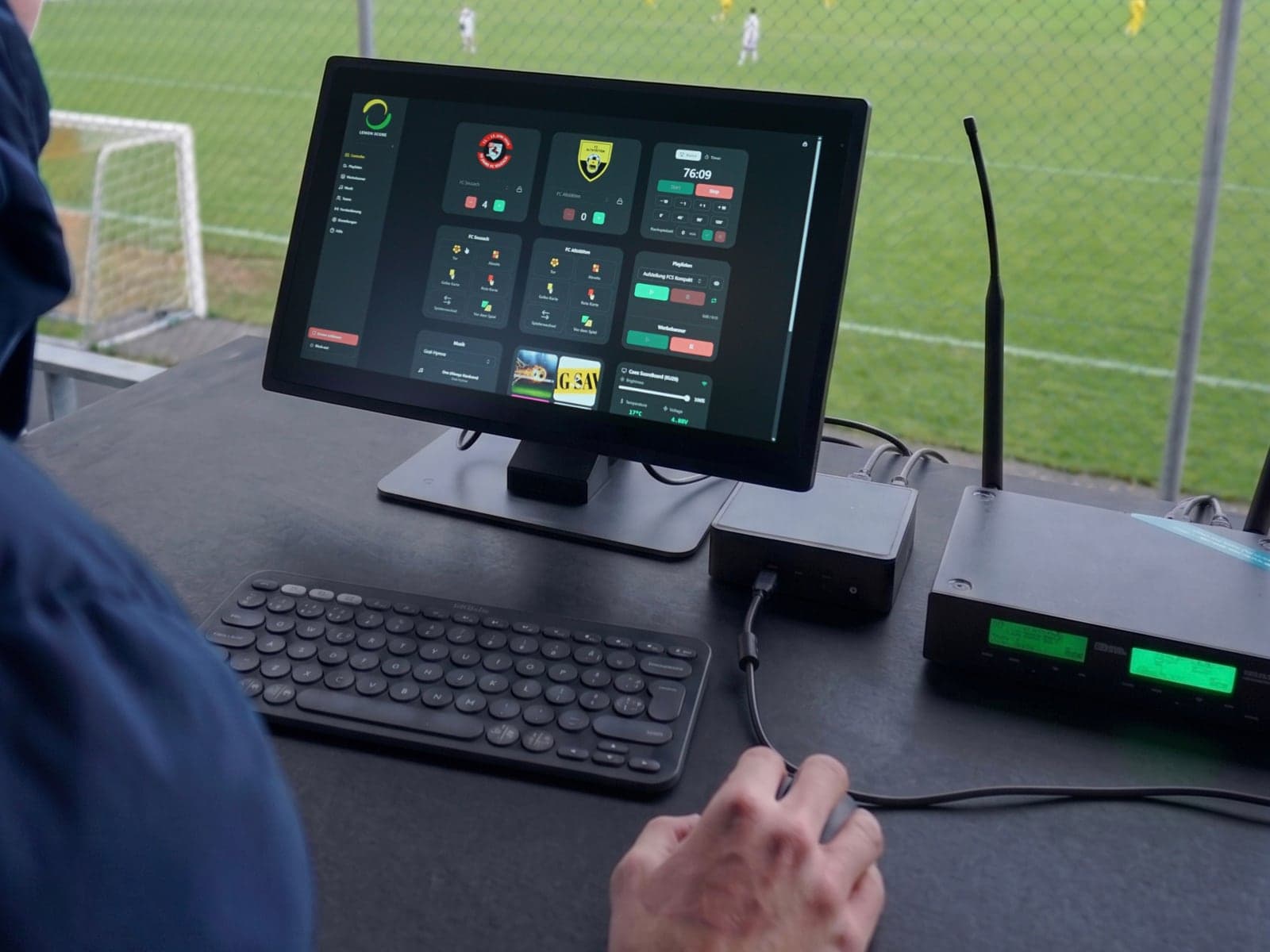
Operation does not have to happen on a laptop in the clubhouse. With the remote control, you operate the scoreboard from the touchline by phone or tablet, on the local Wi-Fi and PIN-protected. Anyone who runs matches regularly assigns buttons for kick-off, half-time and goal to a Stream Deck; increasing the score and triggering the goal animation can be combined there as a multi-action on a single button. More on this under operating the scoreboard and in the article on the remote function.
Interruptions, thunderstorms, floodlight failure
In the event of a longer interruption (injury with an ambulance, thunderstorm, floodlight failure), the referee suspends the match. When play resumes, ask him for the official match minute and set the board via time correction (to the second, even while the clock is running) or manual time entry. If there is a dispute about the clock: adjust the board, do not argue (Law 7).
Typical operating mistakes and how to avoid them
A short checklist you can pin up at the operator's station:
- Clock keeps running during the break. Stop after 45:00, then start the half-time countdown (timer mode) or leave the clock standing.
- Wrong half displayed. Before the second-half kick-off, press quick-select 45', then start on the whistle.
- Clock not stopped at 90:00. Activate automatic stop in the settings, then this no longer happens.
- Stoppage time without an announcement. Take the number from the fourth official or referee, enter it on the board ("90:00 +3") and announce it over the PA.
- Clock starts before the kick-off. Finger on start, eyes on the referee, not on the ball.
- Mode switched mid-match. Switching between match and timer resets the time. Only switch during the break.
Hardware match clock or software on a screen?
Classic match clocks for the football pitch are digit displays with a clock and score, for example from Mobatime, Bär Timing or Stramatel, available in Switzerland through sports retailers such as Sport-Thieme (prices on request, depending on the supplier). They are robust, but show only numbers: no logos, no goalscorers, no sponsors, no penalty shootout.
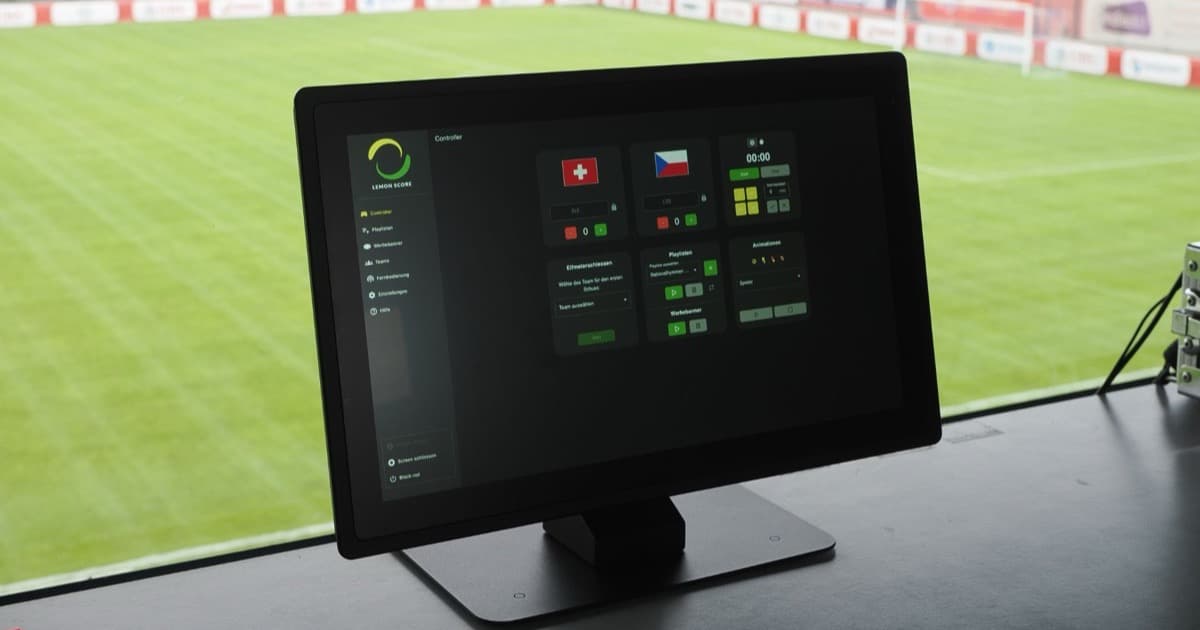
The alternative is a match clock as software on a TV, projector or LED wall. There, the clock is one element in the layout, combined with the score, logos, animations and sponsor banners. Ready-made layouts can be found under templates.
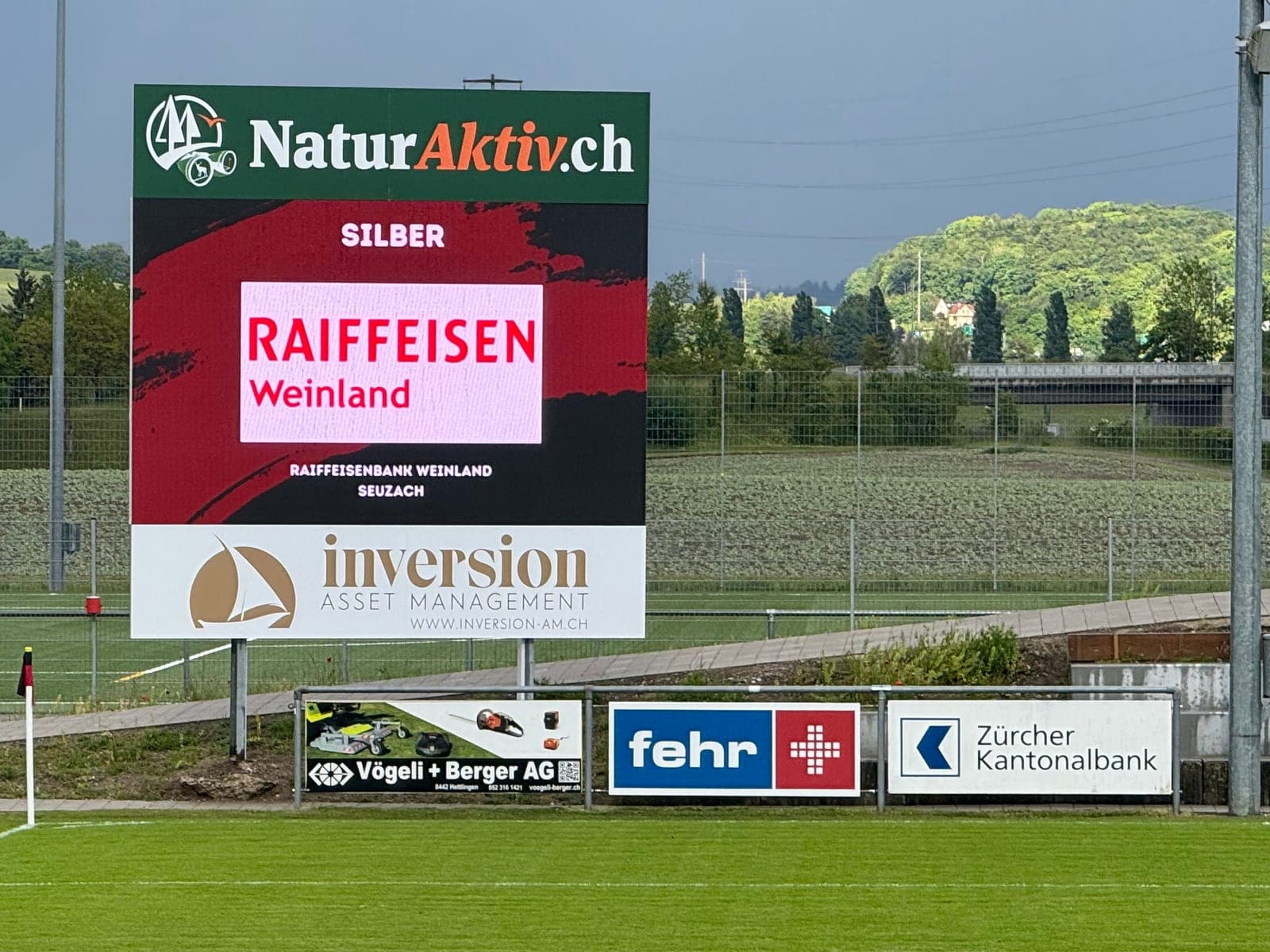
A side effect: the match clock is one of the most-watched spaces at the ground, which is why some clubs sell a "match clock sponsor". On a digital scoreboard, this space can be marketed several times over with rotating banners; more on this under advertising on the scoreboard.
Frequently asked questions about the match clock in football
May the match clock count down?
For the match itself, a countdown is unusual, because the match minute is counted upwards. For the half-time break, the warm-up and tournament formats in the F and G youth categories, however, it makes sense.
Does stoppage time have to be shown on the scoreboard?
No. In amateur football, communication via the fourth official's substitution board or an announcement is sufficient. Showing "90:00 +3" on the board is an optional extra service. The professional leagues (Bundesliga from 2026, Super League from 2026/27) have their own rules, which are not binding for amateur matches.
Who stops the clock on the scoreboard?
The home club's scoreboard operator, once regular playing time has elapsed at 45:00 and 90:00. The software can do this automatically. The referee only stops his own watch during stoppages and is not responsible for the board.
What applies in youth football?
The match length depends on the category and match format according to the SFV and the regional association, from 2 x 45 minutes for the A juniors to short tournament games for F and G. Halves that do not end at 45 or 90 are stopped manually.
What if the clock on the board is running incorrectly?
During play, adjust it via time correction in one-second steps, or synchronise with the referee at the next stoppage. The board follows the referee, never the other way round.
Conclusion
The match clock in football is information, not authority: the referee keeps the time, the scoreboard follows. Anyone who stops the clock at 45:00 and 90:00, shows and announces stoppage time as an addition, defines the youth presets before the season and never switches mode mid-match has settled the most common discussions on the touchline. What of the new professional practice reaches amateur football is for the SFV and the regional associations to decide.
How to set up the match clock, stoppage time, automatic stop and timer in LemonScore is shown in the documentation on the match clock; in case it is still a draw after 120 minutes, see the page on the penalty shootout. Both can be tried out with the free 15-minute demo on your own TV before you need them on match day.