Finding Sponsors for a Football Club: 7 Steps
Finding sponsors for a football club in 7 steps: local businesses, sponsorship requests to Raiffeisen, Migros and co., the scoreboard as ad space, proof.

LemonScore
Published on
Every committee knows the problem: expenses are rising, membership fees are maxed out, and the same three patrons cannot give more every year. Finding sponsors is vital for football clubs, yet at the same time it often feels like begging. It does not have to. If you see sponsorship as a deal with real value on both sides, you are not selling pity, you are selling visibility. This article takes you in seven steps from an empty sponsor list to a signed contract, with the addresses Swiss clubs can actually apply to, and with the advertising space that makes the difference.
Step 1: Take stock before you approach anyone
Before the first conversation you need two lists. The first is the inventory of your advertising spaces: perimeter boards on the main pitch, the first team's kit, the match ball, the match programme, website, social media, the catering tent and, if you have one, the scoreboard. The second list is your reach figures: spectators per home match, matches per season on the main pitch (first team, second team, youth teams), newsletter subscribers, followers. A third-division club with 250 spectators and 13 home matches reaches over 3,000 views per season with the first team alone; with youth and second-team matches it quickly becomes 8,000 to 12,000. These numbers are your argument, not the club's history.
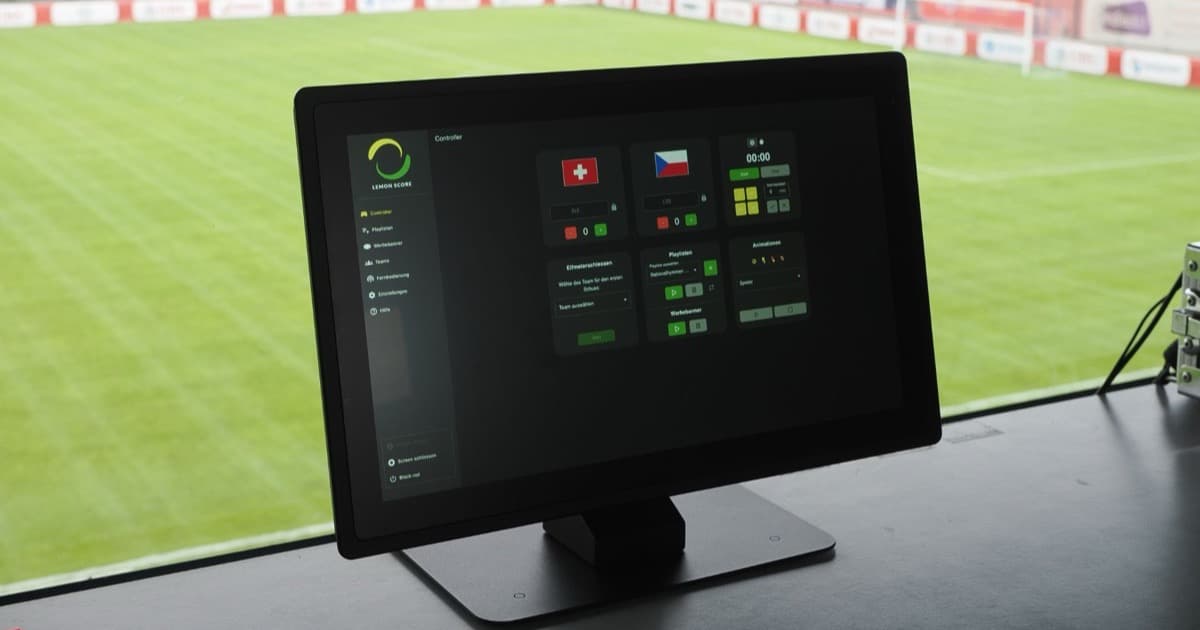
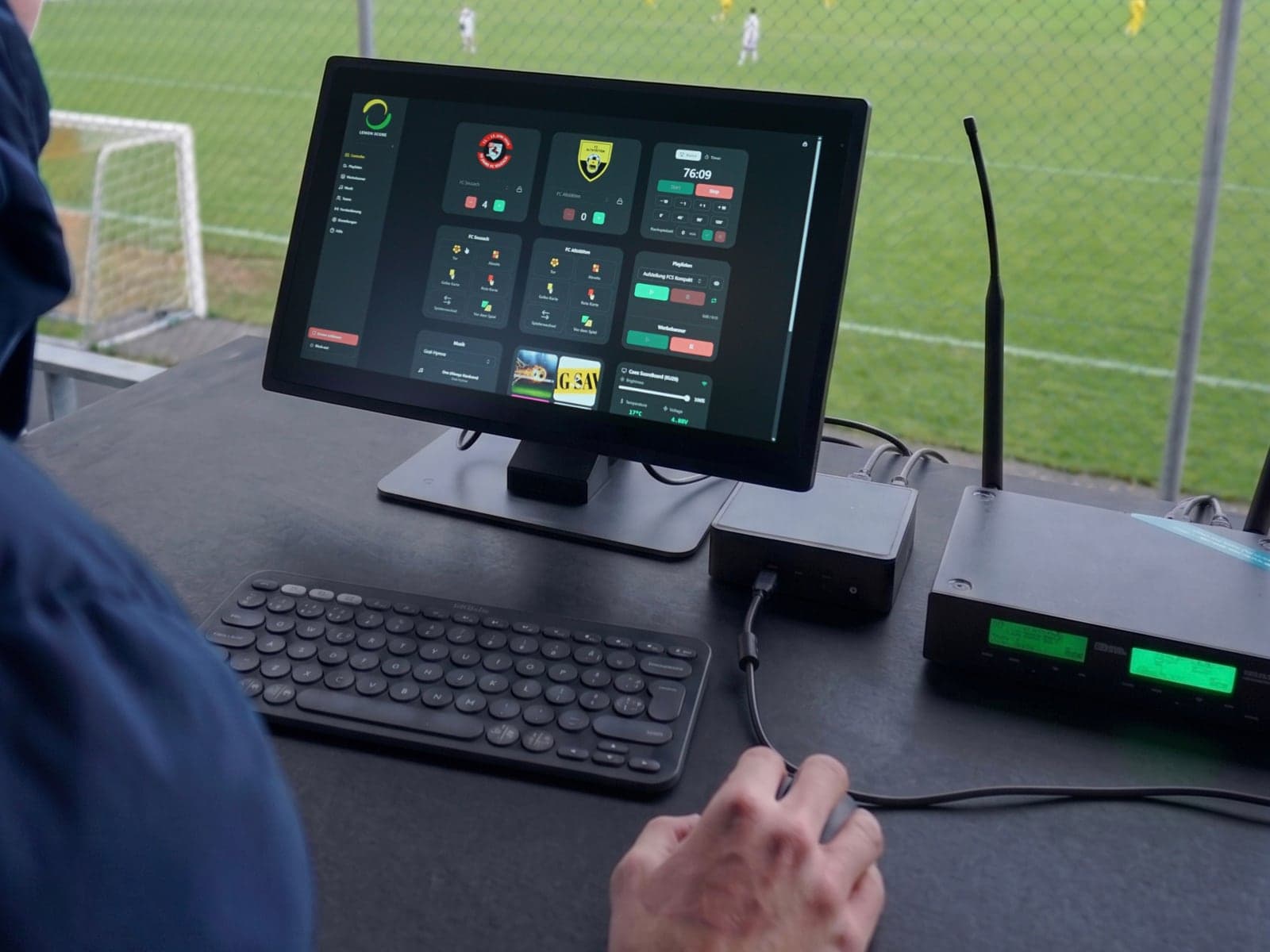
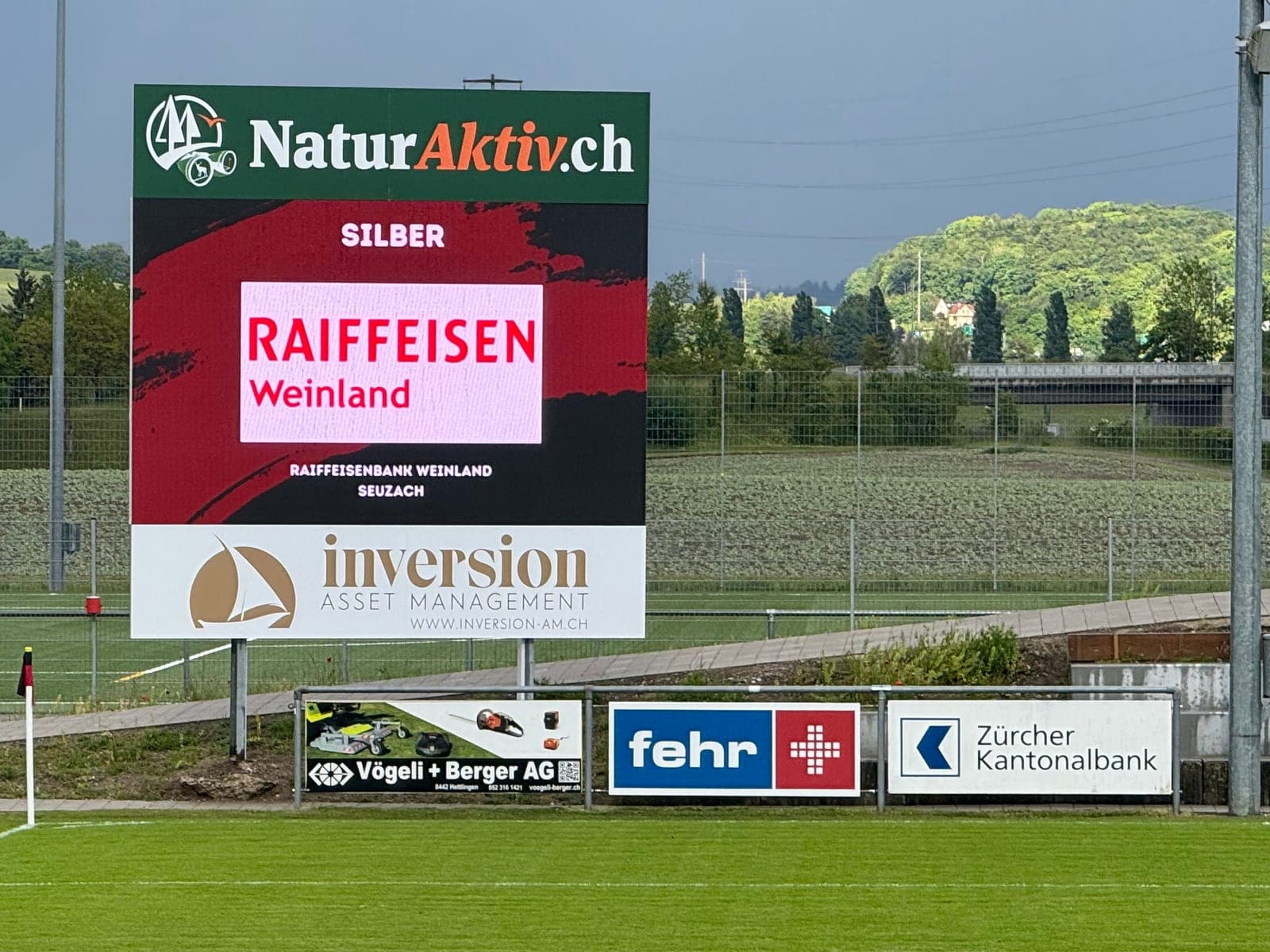
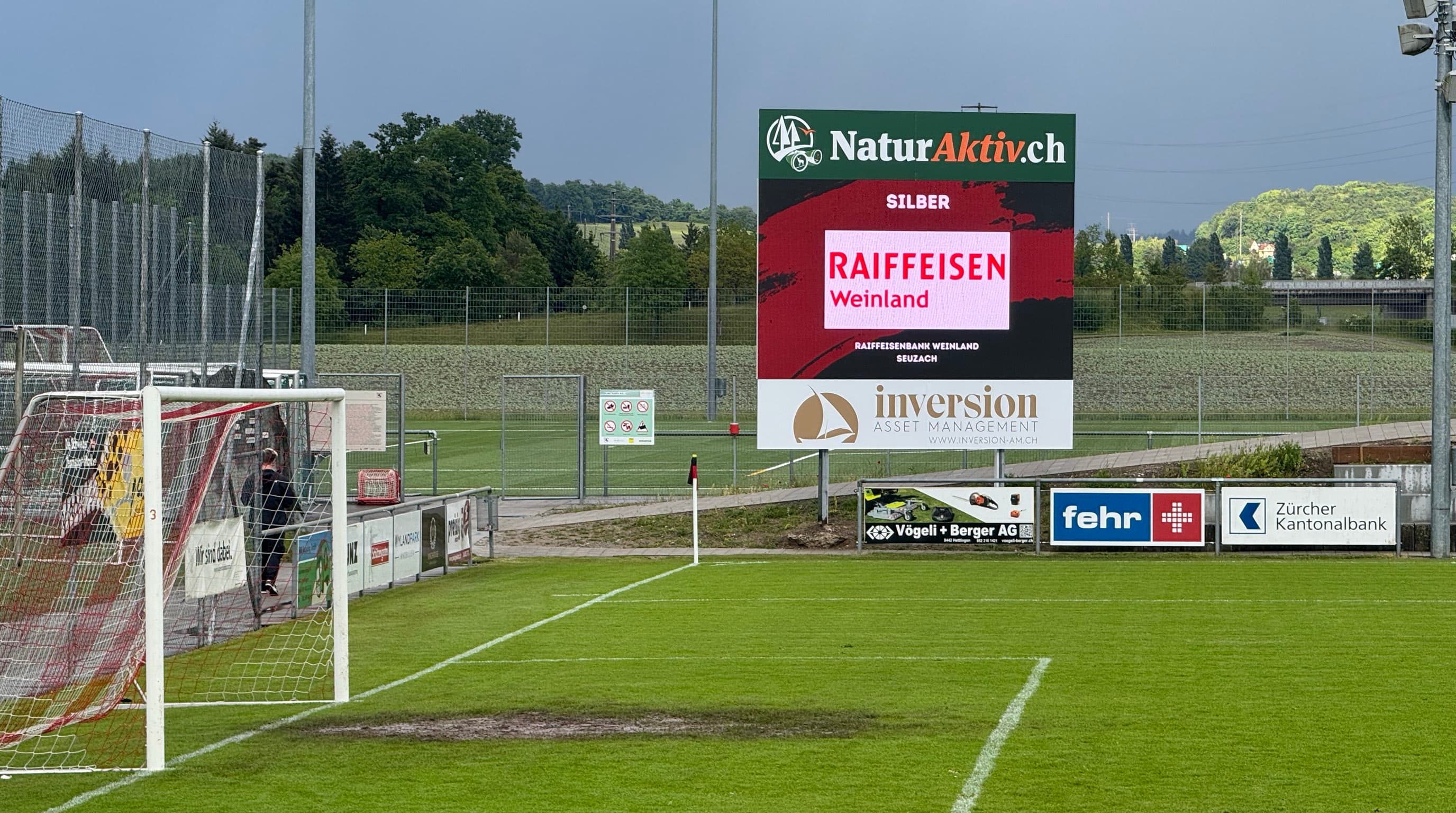
Arrange the spaces in three or four tiers with prices. Our post on scoreboard advertising for sponsors shows what the scoreboard slot looks like in practice, and our post on the FC Seuzach LED screen shows such a wall in practice.
Step 2: Start with local businesses, not large corporations
The bakery on the village square, the plumber, the driving school, the garage: local businesses do not sponsor for reach, they sponsor because they are rooted in the community. Their customers stand at the side of the pitch on Saturday. Draw up a list of all businesses whose owners or employees have a connection to the club (parents of youth players are the best way in) and approach them in person. An email campaign is no substitute for a conversation.
Two further addresses are worth it: the local trade association of your municipality (a slot at its event reaches 30 businesses at once) and the municipality itself, which often co-finances club infrastructure directly or via the Sportfonds; how the application works is explained in our post on the Swisslos Sportfonds (the Swiss lottery's cantonal sports funds).
Step 3: Assess Swiss corporate sponsorship requests realistically
Anyone who searches for "finding sponsors Switzerland" lands on the sponsorship pages of the big brands. To be honest: for an amateur club most of them are not a source of money, but a few have regional programmes where a request is worthwhile. We checked the pages in August 2026:
- Raiffeisen: sponsorship is not handled centrally but by the local Raiffeisen bank, which supports clubs, events and initiatives in its region. In addition there is the crowdfunding platform lokalhelden.ch, which clubs use to finance projects such as a scoreboard.
- Migros-Kulturprozent / Migros-Engagement: the regional cooperatives fund leisure and sport alongside culture and social projects. Applications go through the portal Förderung beantragen, filtered by region and topic.
- Ovomaltine: accepts requests for events only via its standardised sponsorship form, supports with products rather than money and targets events with young families and young adults. Suits a youth tournament, not a perimeter board contract.
- UBS: the sponsorship page explicitly states that an expansion of the portfolio is not planned in the foreseeable future. Save yourself the request.
- Swisscom: the same statement, no expansion of the portfolio planned. Its commitment is to the national teams.
- Zweifel, Intersport, Brack: these brands also appear in search results for club sponsorship. We could not find a public page for sponsorship requests at any of the three; if you want to ask, do so via the general contact form or the nearest branch and expect products and equipment rather than cash.
Rule of thumb: corporate requests are a side track for tournaments and youth events. The season budget comes from local businesses.
Step 4: Offer packages instead of asking for amounts
"We are looking for sponsors" is not an offer. "For CHF 800 per season, your logo appears on our LED scoreboard at every home match, on the website and in the match programme" is one. Three clear tiers with concrete benefits and prices make the decision easy for the business and protect you from endless individual negotiations. Keep the tiers to three or four at most, and describe every benefit in measurable terms (matches, minutes, appearances).
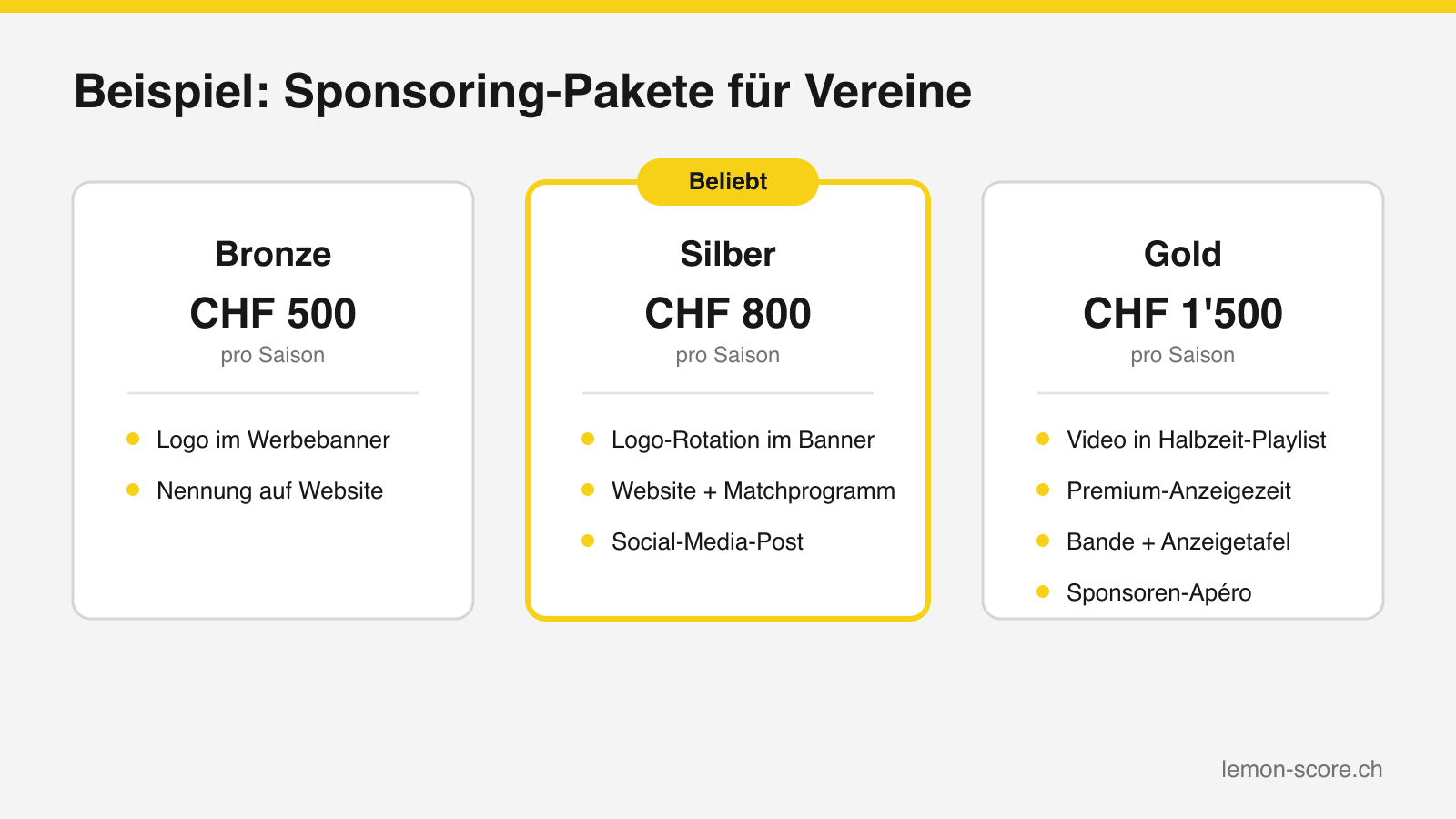
One detail that is often forgotten: production costs. A perimeter board at CHF 350 per season including printing earns nothing in the first year. Show production separately or sell spaces that need no production.
Step 5: Create the advertising space that actually sells
The classic tarpaulin banner is static, weathers, and after three years has become invisible because everyone has got used to it. And the number of boards around the pitch is finite. Advertising on the scoreboard turns this around: moving logos and rotating banners attract attention, several sponsors share the same space, premium partners get the goal animation or the match clock, and the sponsor only supplies a logo file instead of a printed board. For the club this means more sellable slots on the same surface, with no production costs.
A slot on the scoreboard is worth roughly 1.5 to 2 times a single perimeter board; with 8 to 12 sponsors a 3 x 2 m wall pays for itself in two to three seasons. The difference between a perimeter board and an LED surface is explained in Perimeter advertising vs. LED scoreboard. Our whitepaper on the future of club sponsorship works out how big the potential is in the long run.
Step 6: Prove the value, do not just claim it
Sponsors stay when they can see what they are getting. A one-page sponsorship factsheet with the numbers from step 1 looks more professional than any glossy brochure and gives the business an argument to present to its own accounts department. After the season comes the proof of delivery: a photo of the board, a screenshot of the scoreboard with the logo, the number of appearances from the playlist, the spectator figures. If you send the proof unprompted, you usually no longer have to sell the renewal at all.
Also use events as a stage: the Grümpelturnier (a Swiss amateur fun tournament), the season opening and the youth day bring in an audience that otherwise never comes to the sports ground. Offer event sponsorships (naming, catering tent, raffle) and fill the scoreboard during the breaks with sponsor videos instead of a black screen. For many businesses, sponsoring an event is the low-threshold entry point that turns into a season-long commitment.
Step 7: Keep at it and organise reciprocity
The most common mistake is not the refusal, it is letting things fizzle out. Keep a simple list: who was approached when, who agreed to what, when which contract expires, who receives a thank-you when. One hour of upkeep per month beats any one-off blitz.
The strongest bond forms when the club gives something back: a club discount at the sponsor, a sponsors' aperitif once a season, a profile of the business in the match programme or on social media. If you treat your sponsors as partners rather than as sources of money, contracts practically renew themselves. A contract does not need five pages, but term, notice period, exclusivity, description of benefits and a VAT note belong in it; according to the Swiss Federal Tax Administration, sports clubs run on a voluntary basis only become liable for VAT from CHF 250,000 of taxable turnover per year, so if in doubt ask your accountant.
Frequently asked questions
How many sponsors does an amateur club need?
That depends on the budget, not on a target number. A third- or fourth-division club with 10 to 15 perimeter board sponsors at CHF 300 to 650, two or three kit or main sponsors and a handful of match ball patrons typically covers a five-figure sum per season.
Is a sponsorship request to UBS or Swisscom worthwhile?
Not for amateur clubs: both state on their sponsorship pages that no expansion of the portfolio is planned. Regional programmes (the local Raiffeisen bank, the Migros cooperative's engagement programme) are the more realistic addresses.
What is the best advertising space for new sponsors?
The space in the line of sight: the scoreboard. It is looked at after every goal, needs no production and can be divided among several sponsors. The perimeter board remains the basic product, the scoreboard the upgrade.
Conclusion
Finding sponsors means: know your inventory and your numbers, use local relationships, make a clear tiered offer and deliver visible value. Corporate requests are the exception, local businesses the rule. A modern LED scoreboard is not a cost item here but your best sales argument, because it creates the advertising space you are selling. Our post on the Swisslos Sportfonds shows how clubs finance the purchase, and what the scoreboard costs is explained here. When the board pays for itself is what the sponsor calculator for football clubs works out.